
by: Carol Toole
Carol Toole, trained as a Waldorf Early Childhood teacher and Learning and Dyslexia Specialist, served the Austin Waldorf School for over 40 years as a kindergarten teacher, Enrollment Director, and Student Support Teacher and Coordinator. She developed and oversaw the school’s literacy and dyslexia program. She is author of the book, What is This Childhood, Finding the Spirit of Early Childhood in Language and Creative Living with our Families, SteinerBooks.
A Waldorf parent once shared her daughter’s question, “How does my teacher know the exact stories I will love each year?” A profound aspect of Waldorf education is the view that child development reflects the stages of humanity’s evolution. The curriculum, designed to meet what is unfolding at each phase, enhances the foundational capacities that brought us to this present day. When considering the span of time humans have inhabited the planet, widespread literacy has existed for a mere eye blink. Let’s consider human consciousness in the 100,000 years when an oral culture prevailed, and its relationship to the young child.
For the ancients, language held power; it was alive and generative. In creation myths, the world was sung into being. Spells and chants brought connection, healing, and affected others even from afar. Vestiges of living language exist today in words where sounds elicit a direct, sensory experience or image. For example, whirlpool, splash, rustle, cricket, or expressions such as pining away (the mournful sound of wind in the pines) or making something shipshape (think of all the knots to be tied for a seaworthy vessel).
Without the written word, each culture’s heritage was passed on through recitation of long epic poems and participating in vivid re-enactments and storytelling, calling on capacities of memory and imagination. Keen observation allowed early humans to travel through harsh landscapes, tracking game and finding hidden sources of water and food. Heightened listening allowed some tribes to receive messages from companions in distress over great distances. The discovery of medicinal plants and sustainable farming and hunting practices showed an attuned and intuitive relationship to their environment.
At first, writing also reflected a direct experience of the world. Egyptian pictographs needed thousands of pictures to convey objects and ideas. For efficiency, these gradually became stylized, eventually morphing into rebus writing—a symbol standing for a word part or syllable. Finally, our phonetic alphabet emerged with merely 26 letters and 44 sounds. Yet, this system of a letter representing one sound in our language is highly abstract. Good readers first map the smallest sounds of speech onto each letter or letters. Language is broken into parts before making it whole again toward instant recognition of a word.
MaryAnn Wolf, in her book Proust and the Squid, outlines this tremendous shift in the human brain from using visual circuits for object recognition and oral language to forming new pathways to linguistic areas needed for deciphering abstract symbols and written language. What took humanity 2000 years to achieve, every child must acquire in a few short years. Learning to read is an arduous journey for many, and this leap into a linear and analytical task eventually dims the sensory, pictorial, and intuitive relationship to the environment innate to both our children and our ancestors. We certainly see this in our next evolutionary phase to digital literacy.
This explains some children’s antipathy to mere lines and curves, “skeletal and bloodless” as described by the writer Thomas Wolfe. As one dyslexic and artistically gifted student lamented, “I don’t like looking at letters, they’re not pretty.” For her, the code was cracked when she drew characters for each letter, each with their own biography—Rosy R ate radishes and wore a ruby necklace, a wreath of roses, and red rubber boots in the rain!
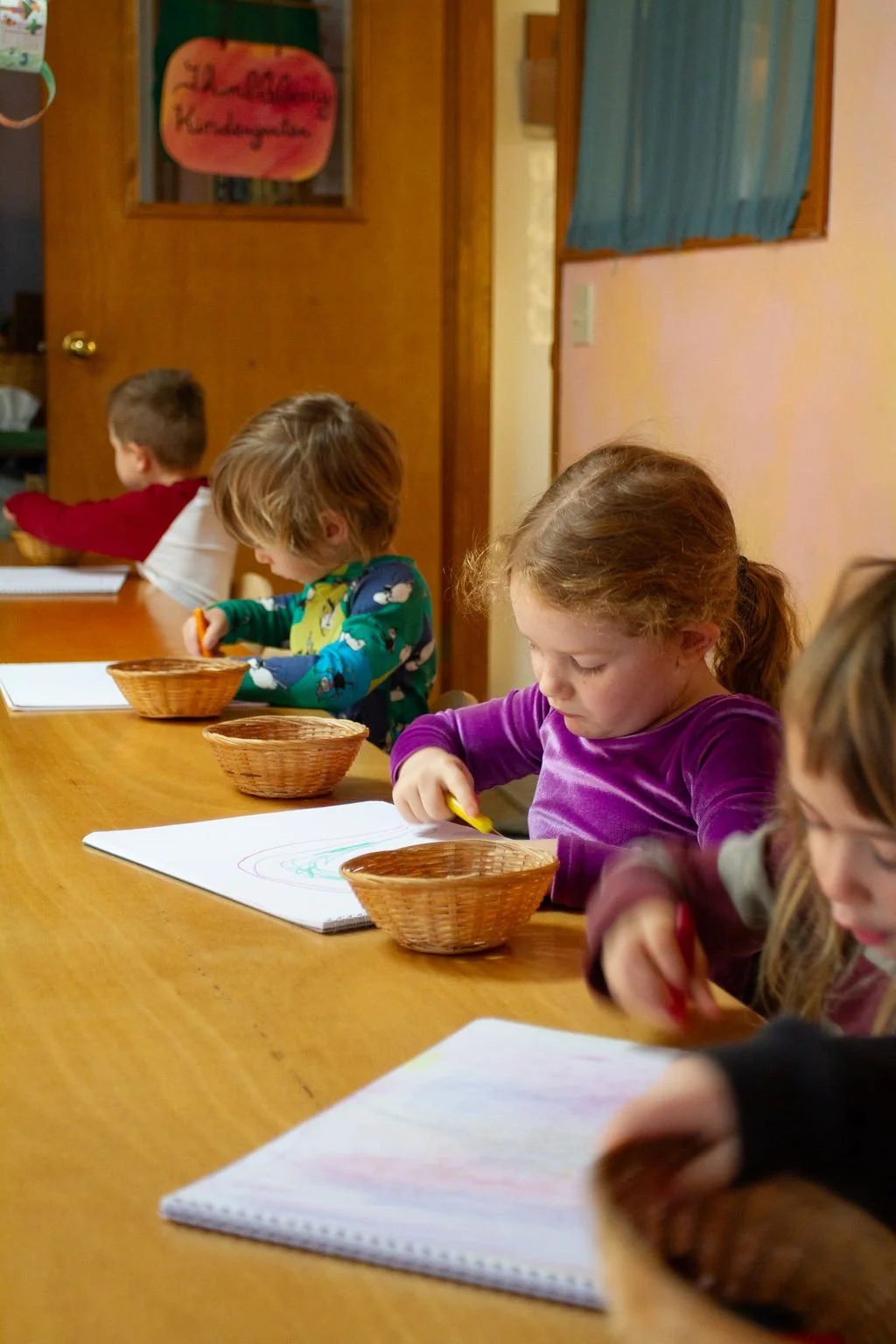
The Waldorf play/movement oriented kindergarten prioritizes oral language, the natural realm of the young child whose sense for language is playful and alive. Sound, poetry, and story foster this direct, open-ended experience of the world and lay strong foundations for literacy. Abundant rhymes and alliteration attune children to sounds at the beginning and ending of words. A well developed phonological awareness allows the child to hear individual sounds in words, a skill needed to eventually map sound onto symbols, to hold them in order for decoding, and to recognize chunks such as suffix endings. Hearing fairy and folk tales over time develops their attention span, memory, and picture making capacities. Kindergarteners become familiar with complex vocabulary, sentences, and story structure. Fairy tales' neat packaging of repetitive trials seeds the concept of conflict, cause and effect, and resolution.
Play allows the child to develop inner speech, a key ingredient of executive functioning and metacognition. Movement and time in nature strengthen visual tracking skills (eyes that skip on the page tire easily) and help connect the left and right hemispheres of the brain, both needed for the tasks of sounding out words and comprehension. In first grade when direct reading instruction starts, a mature sensory system will more readily begin to integrate the visual, verbal, auditory, and semantic cues in a word in the milliseconds needed to have energy left over to imagine distant lands, try on the experience of others, connect their personal journey, and simply wonder.
It takes time to journey from learning to read to reading to learn. In Literacy Researcher Jeanne Chall’s Stages of Reading Development, fluency emerges in approximately grades 2-3 and proficiency for reading to learn new material in grades 4-8. Children in a Waldorf School are given the time to preserve vital capacities and to land gently from a concrete world of perception and meaning to more abstract, logical thinking. This richness of language and experience will serve to enhance lifelong joy in reading and writing.
Some rhyming and phonemic awareness games:
Rhyme omission (poem courtesy of Ogden Nash):
God in his wisdom Invented the fly,
Then forgot to tell us ______. (why)
In the following, for each repetition, replace the animal and discover its rhyme:
A-hunting we will go
Heigh ho, the derry-o,
A-hunting we will go.
A-hunting we will go,
A-hunting we will go,
We’ll catch a fox
And put him in a _____, (box)
And then we’ll let him go!
Finally, slow motion words: Give your child instructions such as “put on your shoes", “carry your lunch box” speaking very slowly, almost separating each sound.
For further exploration:
Jeanne Chall, Stages of Reading Development
Stanislas Dehaene, Reading and the Brain: The New Science of How We Read
Sally Shaywitz, Overcoming Dyslexia
Maryanne Wolf, Proust and the Squid: The Story and Science of the Reading Brain
Reader Come Home: The Reading Brain in a Digital World