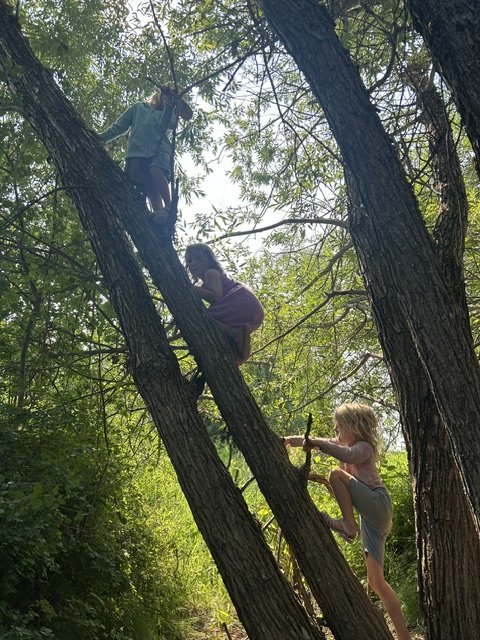
At Sandpoint Waldorf School, we believe childhood is a time for exploration, discovery, and developing confidence through meaningful experiences. Sometimes, that means climbing a tree, balancing on a log, running down a hill, or venturing into the woods to see what lies beyond the next bend. These moments may bring a little uncertainty, but they also offer children something invaluable: the opportunity to discover what they are capable of.
As parents and educators, we naturally want to keep children safe. But what if protecting children also means allowing them the freedom to take appropriate risks?
Why risky play matters
A 2024 position statement published in Paediatrics & Child Health, titled “Healthy childhood development through outdoor risky play: Navigating the balance with injury prevention,” explores the important role that outdoor play plays in children's physical, mental, and social-emotional development.
The authors, Emilie Beaulieu and Suzanne Beno, describe risky play as exciting, child-directed play that involves uncertainty and the possibility of physical injury. This might include climbing to a height, jumping, running at speed, exploring natural spaces, using tools with appropriate supervision, or engaging in rough-and-tumble play.
The research highlights several potential benefits of these experiences, including improved physical activity, stronger problem-solving abilities, greater self-esteem, and opportunities to develop resilience, cooperation, and conflict-resolution skills. Encountering manageable challenges can also help children become more comfortable with uncertainty and learn to navigate fear.
In other words, when children are given opportunities to test their limits, they are not simply playing. They are practicing skills that will serve them throughout their lives.
Read the full article in Paediatrics & Child Health.
A natural fit with Waldorf education
Waldorf education recognizes that children learn through far more than books and formal instruction. Especially in the early years, children need time to move, imagine, create, build relationships, and experience the natural world firsthand.
At Sandpoint Waldorf School, outdoor experiences and imaginative play are meaningful parts of childhood. Whether children are navigating uneven ground, building with natural materials, playing cooperatively, or discovering the changing seasons, these experiences invite them to engage their whole selves—body, mind, and heart.
When a child climbs a tree, for example, they are doing much more than strengthening their muscles. They are assessing distance, testing balance, making decisions, recognizing their limits, and learning to trust their own judgment. When children negotiate the rules of a game or work together to build a fort, they practice communication, cooperation, and conflict resolution.
These lessons cannot always be taught through direct instruction. They emerge through experience, repetition, and the freedom to work through challenges at a developmentally appropriate pace.
Waldorf education seeks to make room for this kind of learning, honoring childhood as a vital stage of development rather than rushing children toward the next academic milestone.
Safety and risk can coexist
Allowing children to take risks does not mean disregarding safety. The distinction between a manageable risk and an unacceptable hazard is essential.
The authors of the journal article encourage adults to identify and reduce hazards while preserving opportunities for children to take appropriate, self-directed risks. A child deciding how high to climb, for instance, is different from a child encountering a rotten branch that could break without warning.
Our role as adults is not necessarily to eliminate every challenge. Instead, we can create environments where children have room to explore while providing guidance and supervision that reflect their individual abilities, developmental stages, and needs.
This approach asks us to pause before automatically stepping in. Can the child assess the situation? Are they working through a challenge they can reasonably manage? Would a little more time allow them to find their own solution?
Sometimes, the most valuable support we can offer is the space to try.
Making room for a little uncertainty
In a world where children's lives are increasingly structured and supervised, opportunities for spontaneous outdoor play can become limited. Yet children need time that belongs to them—time to follow their curiosity, invent their own games, encounter manageable challenges, and learn through trial and error.
Risky play invites us to reconsider what it means to keep children safe and what they need to thrive. Rather than aiming to prevent every scrape or moment of uncertainty, we can work toward an approach that protects children from serious harm while allowing them to build confidence, judgment, and resilience.
At Sandpoint Waldorf School, we value the lessons that unfold when children have the opportunity to engage with the world directly. Growth often begins at the edge of what feels familiar, and childhood should offer plenty of safe-enough opportunities to explore that edge.
Join us for a conversation about risky play
How do we balance our natural desire to protect children with their need for independence, challenge, and discovery? How can we recognize the difference between a meaningful risk and a genuine hazard? And how can families and educators create more opportunities for children to develop confidence through outdoor play?
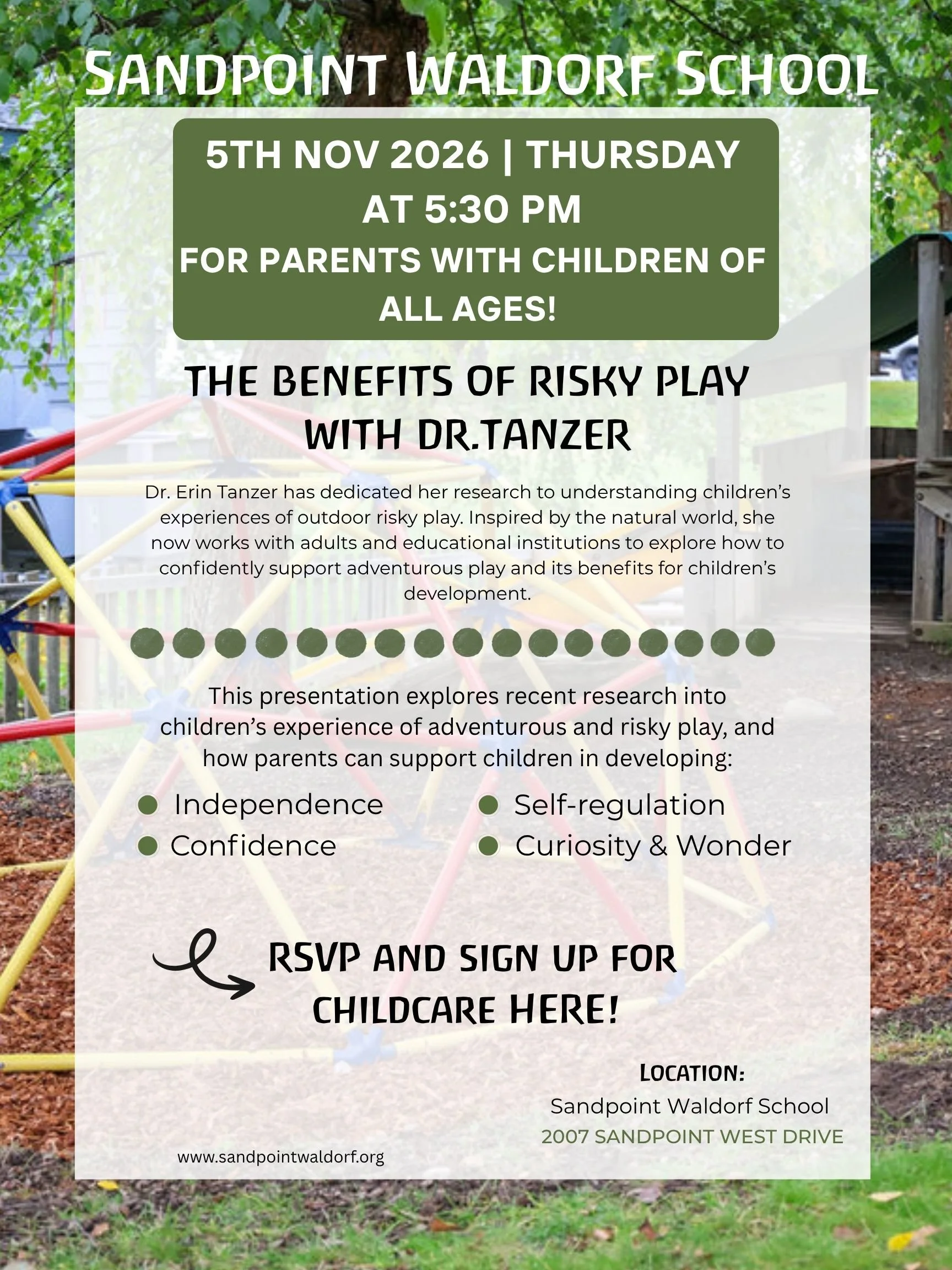
Join us at Sandpoint Waldorf School on November 5 at 5:30 PM for a special talk on risky play with Dr. Erin Tanzer from Antioch University.
Together, we'll explore why children benefit from opportunities to take appropriate risks, how adults can support healthy exploration, and what it means to nurture capable, confident, and resilient children.
We look forward to welcoming our school community and all who are interested in supporting healthy childhood development.
Let's give children the space to explore, the confidence to try, and the opportunity to discover what they can do.